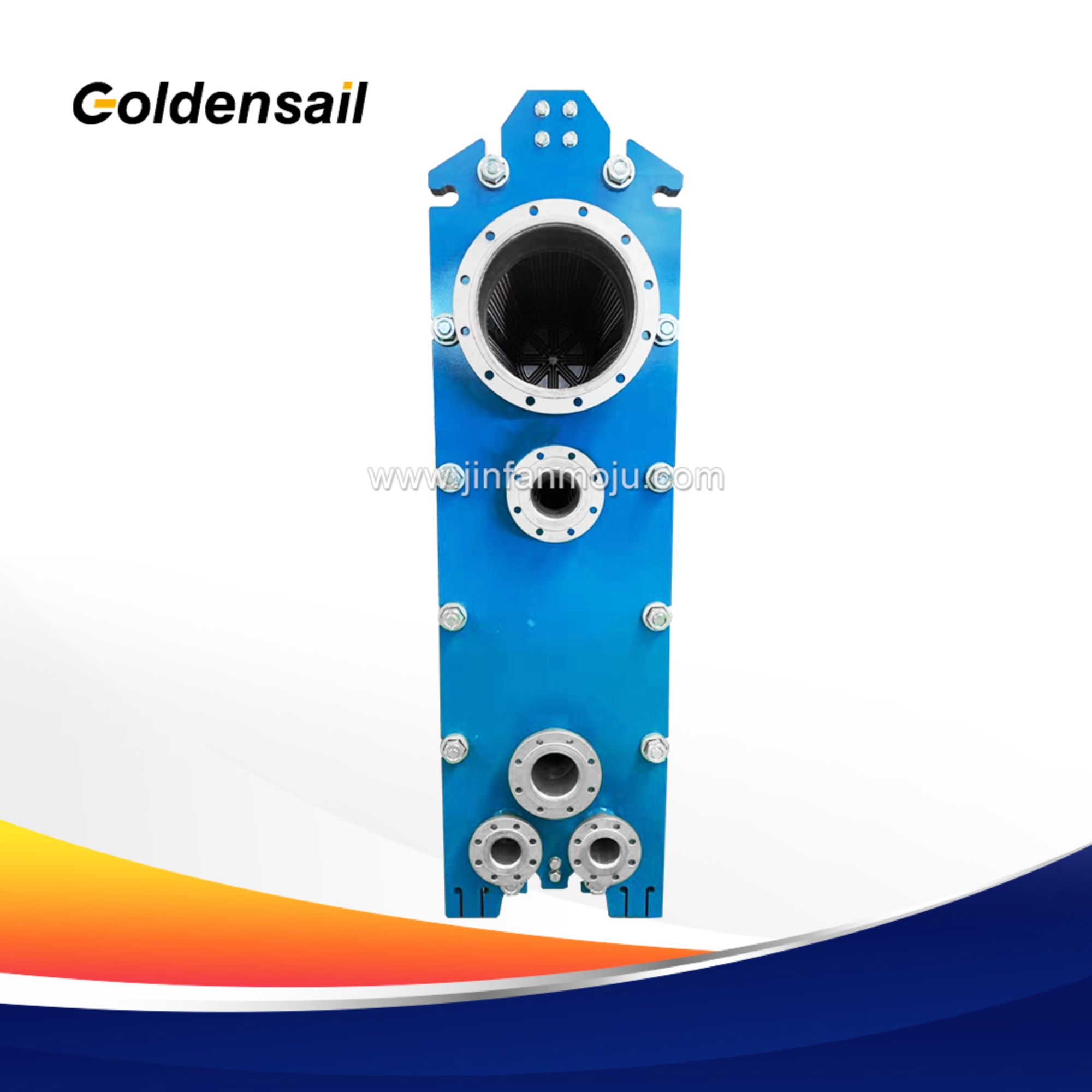
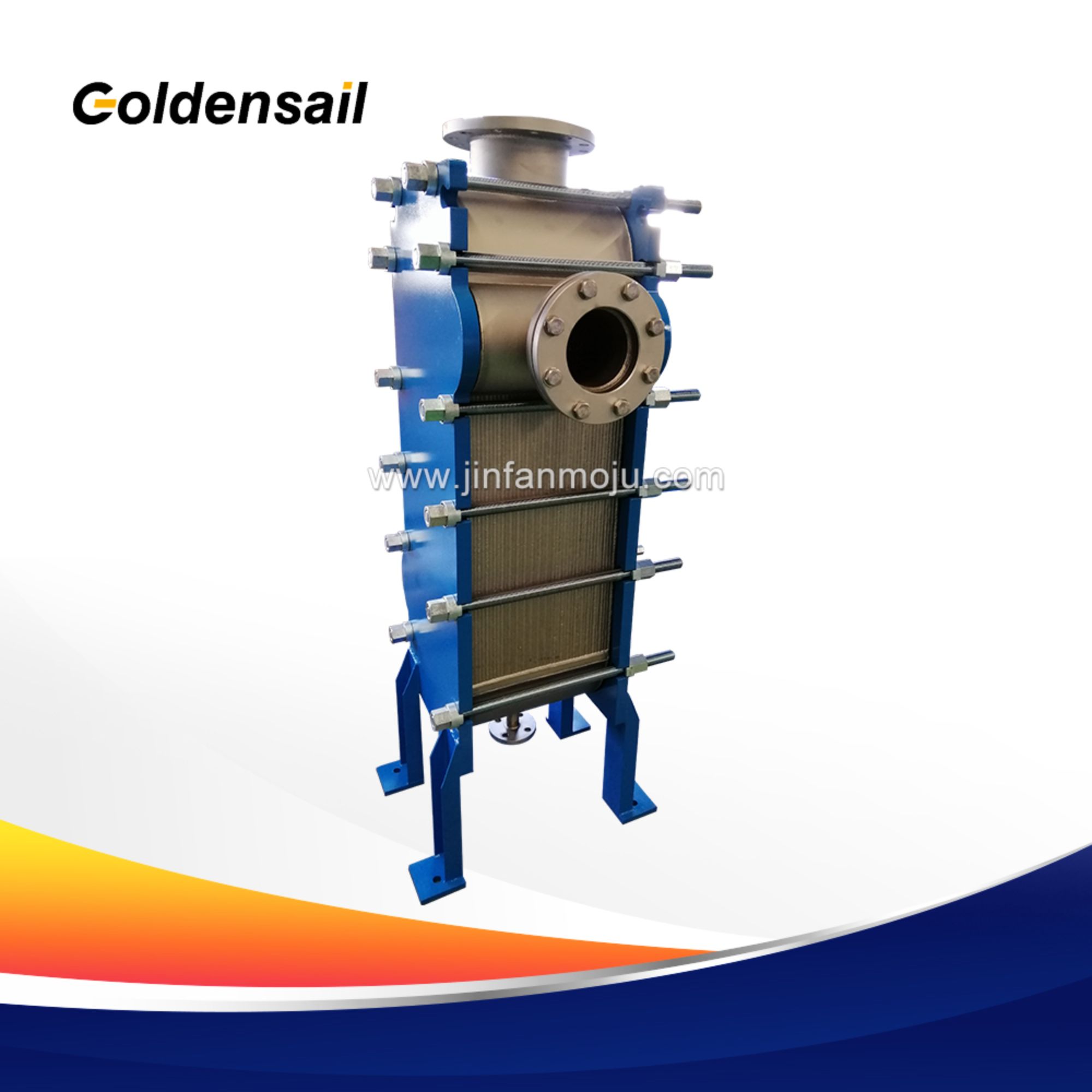
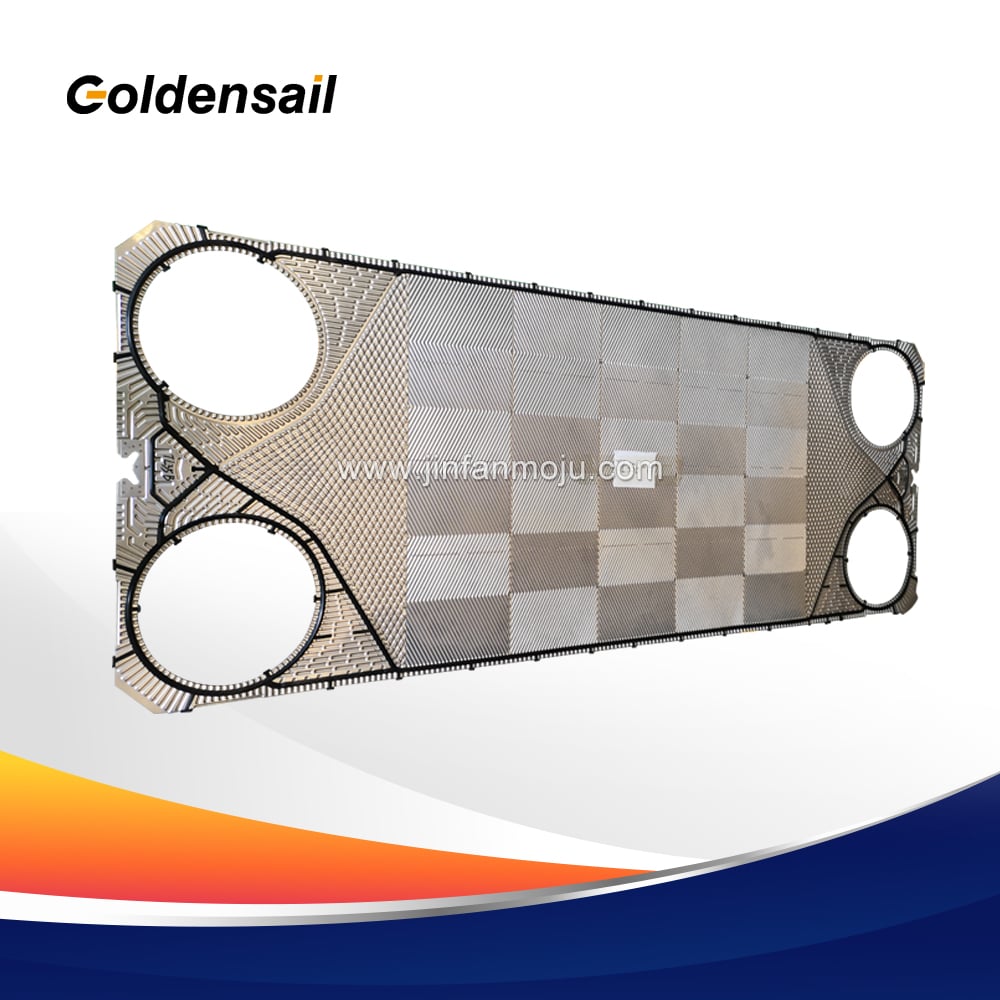
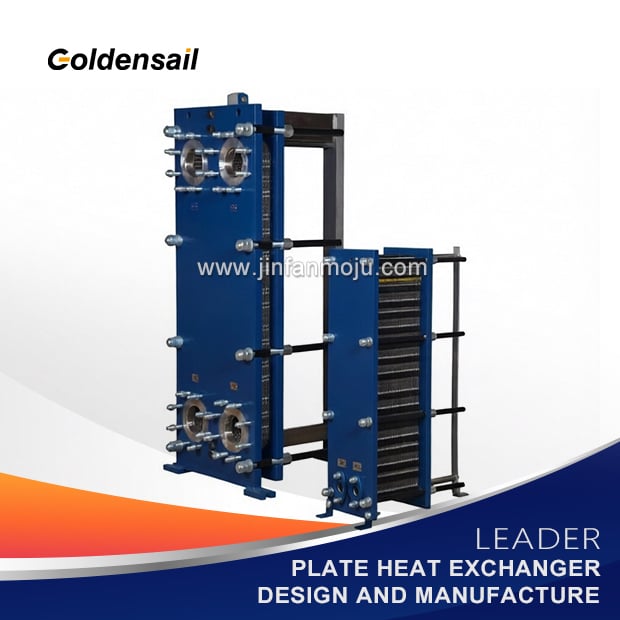
A fully welded plate heat exchanger keeps the thermal performance and the footprint of a plate pack, then removes the one component that limits almost everything else: the elastomer gasket. Adjacent plates are joined by laser or TIG welding, so the pressure boundary is metal from port to port and no rubber sits in the process fluid.
That single design decision explains every advantage in this article and every drawback as well. Below we cover the construction and how it works, six advantages tied to the duties that justify them, five limitations examined without marketing gloss, and the selection tests that decide between welded, semi-welded and gasketed. Each limitation is paired with what JINFAN does in its own welded range — including the cases where the honest answer is a different construction.
01 / SEAL
No gasket in the pack
Plate pairs are welded along the perimeter and at the contact points. The frame only clamps; it does not seal.
02 / DUTY WINDOW
Pressure and heat
Welded units are quoted to roughly 4.5 MPa and 350 °C, with the exact ceiling set by plate alloy and weld procedure.
03 / TRADE-OFF
Access is the cost
Nothing opens. Cleaning has to be chemical, and the surface area cannot be changed later by adding plates.
04 / DECISION
Fouling decides
Specify welded when the gasket is the weakest link. Specify gasketed when mechanical cleaning is the binding constraint.
A fully welded plate heat exchanger is a plate-type unit in which the channel between adjacent plates is sealed by a welded metal joint instead of a gasket. Hot and cold fluids still alternate through corrugated channels and still exchange heat across a thin plate wall, but the plate pack itself contains no elastomer in contact with either medium. The frame and tie rods hold the pack together and carry the connections; they no longer provide the seal.
The construction exists because the gasket, not the plate, is usually what limits a plate heat exchanger. Once the joint is welded, the operating envelope is set by the alloy, the weld and the plate thickness rather than by the temperature rating of NBR or EPDM.
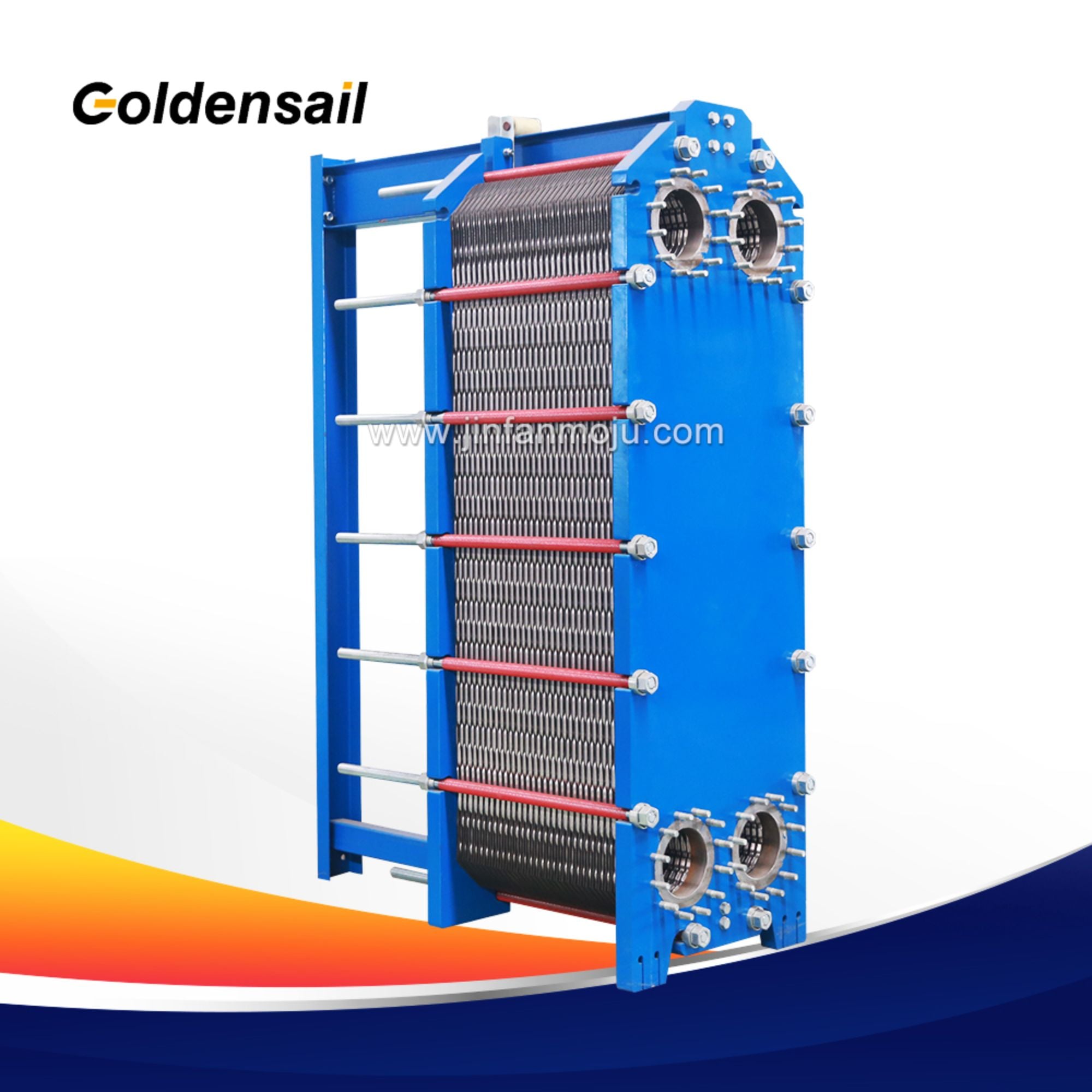
The plate pair is the pressure boundary
Two plates are pressed as a mirror pair and welded around the perimeter, closing the channel between them. Laser welding gives a narrow, low-distortion seam at speed; TIG is used where the joint is more accessible or the section thicker. The weld carries the differential pressure, so the frame is free to be a clamp rather than a seal.
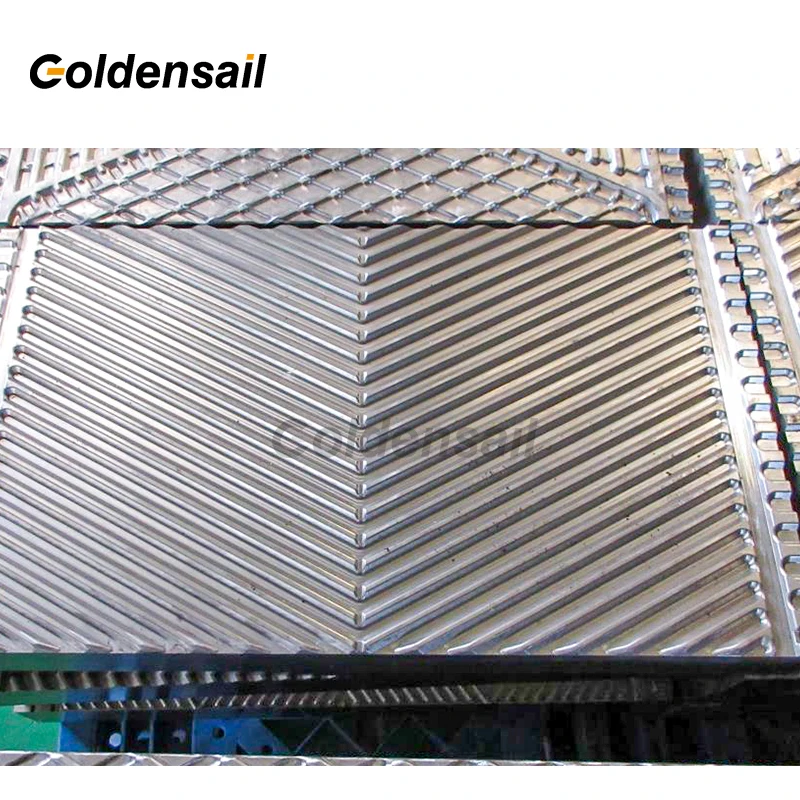
The corrugation does two jobs at once
A fishbone or diamond pattern breaks up the boundary layer to raise the heat transfer coefficient, and its contact points support one plate against the next so a 0.4–1.0 mm wall can resist several bar of differential pressure. Pattern depth and angle decide both the thermal performance and the pressure drop.
Ports, frame and testing
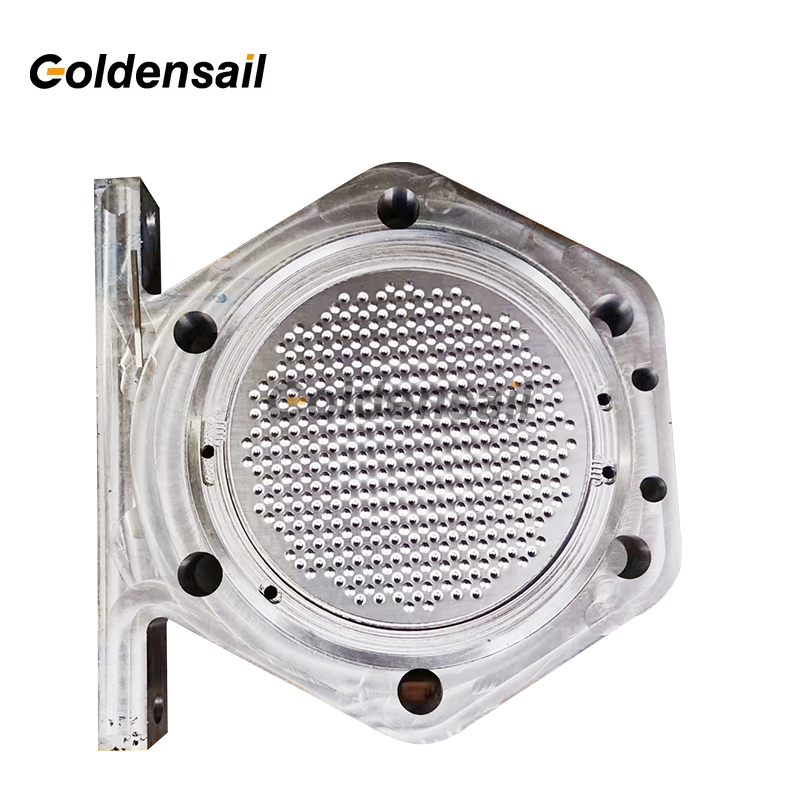
Inlet and outlet connections are welded to the pack or to the shell, so there is no gasket at the port either — a leak path that gasketed units often develop after years of thermal cycling. The assembled unit goes through pressure and leak testing before release.
None of the advantages below are marketing abstractions. Each one follows from the same physical change — a welded joint where a gasket used to be — and each one only pays off under a particular set of operating conditions. We have tied every point to the duties where it actually matters, because a welded unit specified on the wrong duty is a more expensive way of getting the same result.
A gasket seals by being squeezed, and everything that happens in service works against that squeeze. At temperature the elastomer relaxes and takes a permanent set; at pressure it creeps into the gap it is meant to close; after enough hot–cold cycles it hardens and loses elasticity. Gasketed units therefore carry a rating that is really a compromise: the plate pack could take more, but the joint cannot.
Welding removes that compromise. The joint is fused metal, so its strength is close to that of the plate itself, and the frame only has to clamp the pack rather than generate sealing load. In practice this is what allows a plate unit to be quoted into duties that used to be reserved for shell-and-tube: saturated steam above about 10 bar(g), high-pressure district heating substations at 16–25 bar, thermal oil service in the 250–300 °C range, and high-pressure CIP at 80–90 °C. In JINFAN's welded range, units are quoted to roughly 4.5 MPa and 350 °C, with the exact figure confirmed per project against plate alloy, weld procedure and the pressure at that temperature.
The commercial effect is smaller than the engineering effect but easier to see: a steam heater sized as a welded pack is compact and needs no water treatment programme for a hot-water circuit, and a high-pressure duty no longer forces the plant back to a tubular exchanger with three times the floor area.
Most plate exchanger leaks in service are gasket leaks, and most gasket leaks start at the same place: the groove, after a thermal cycle has moved the plates relative to each other. A welded seam has no groove and no relative movement. It also cannot swell, harden, absorb the process fluid or fail progressively — it either passes a leak test at the workshop or it does not.
This matters most on duties with frequent start and stop. A heat recovery unit that cycles by 30–50 K every shift, a chiller that follows an intermittent process load, or a unit that sees pump-switching pressure spikes will work a gasket hard; the same duty is unremarkable for a welded pack. The same argument applies to fluids where a leak is not just a maintenance issue: ammonia, CO2 and flammable refrigerants, where a gasket leak becomes a reportable emission, and hazardous chemicals where the leak path leads directly to atmosphere.
Two further points are worth knowing at specification stage. Welded packs can be helium leak-tested, which detects rates far below what a hydrostatic test shows. And where a double wall is used, a detection gap between the two plate walls turns a pinhole into a visible indication instead of a cross-contamination event — a detail that matters in food, pharmaceutical and refrigerant service.
The chevron corrugation keeps the fluid turbulent at low velocity, which pushes the heat transfer coefficient up by roughly an order of magnitude against a plain tube at the same pumping power. The wall is thin, the hydraulic diameter is small, and the result is a unit that fits a given duty into a fraction of the volume of a shell-and-tube exchanger.
For a buyer, that shows up in three places. Skid and container installations — data-centre coolant distribution units, offshore modules, packaged chillers — are often limited by footprint rather than by thermal duty, and a welded plate pack is frequently the only plate option that fits the pressure class. Retrofits into an existing plant room gain capacity without new civil work. And because the approach temperature can be held to one or two kelvin, low-grade waste heat that a tubular unit would leave in the drain can be recovered instead; on flue gas condensate, jacket water or dryer exhaust, that difference is often the whole economic case.
It is worth being precise about the trade: the same turbulence that raises the coefficient also raises pressure drop, and a compact pack has less room for fouling margin than a generous tubular unit. Compactness is an advantage when the duty is clean and the pump head is available, and a liability when neither is true.
With no elastomer in the wetted path, material selection is no longer constrained by what a gasket can survive. That widens the fluid list considerably. Seawater and brine go to titanium; chlorinated and high-chloride process streams to 254 SMO or titanium; hydrochloric and mixed acids to Hastelloy C276 or C2000; hot caustic to nickel or high-nickel alloy. JINFAN presses plates in 304, 316L, titanium, Ti-Pd, Hastelloy C276, C2000 and nickel, in thicknesses from 0.4 to 1.0 mm, so the alloy can be matched to the chemistry rather than to the gasket.
The weld itself becomes part of the material decision. Heat-affected zones in some alloys are more sensitive to chloride than the parent plate, and filler or autogenous welding has to be chosen with the same care as the plate grade. That is why a corrosion-resistant plate with a poorly matched weld is not a corrosion-resistant exchanger, and why the material question should be answered with a water analysis in hand rather than with a grade name.
For hazardous media the argument is simpler. A gasket that is attacked by the process becomes a leak path to the plant room; a welded boundary keeps the fluid inside the pack until the plate itself is penetrated. Where the fluid is toxic, flammable or expensive, that difference usually decides the construction before the thermal design is even started.
A gasket is a consumable, and gasketed exchangers are maintained around that fact: a set of spares on the shelf, a shutdown every few years to change them, and a re-torque procedure that has to be followed correctly or the unit leaks on restart. On a large unit with several hundred gaskets, the replacement itself is a multi-day job with scaffolding, torque records and a real risk of a mis-seated ring on reassembly.
A welded pack removes the consumable and the reassembly risk in one step. Maintenance attention moves from parts to condition: pressure drop and approach temperature become the indicators, and a rising trend triggers a cleaning cycle rather than a parts order. For plants where the exchanger sits in a continuous process, that shift is worth more than the gasket cost — it changes a planned outage into a monitoring routine.
The secondary benefit is often overlooked. Gasket inventories, shelf-life control, model-number matching across a mixed fleet and the logistics of getting the right ring to site are all recurring overheads. Removing them from the maintenance plan simplifies the whole asset, not just the exchanger.
Within the welded family the execution can be adapted quite widely: single-pass or multi-pass, symmetric or asymmetric channels, wide-gap welded patterns for solids-bearing streams, cassette or block construction, plate-and-frame or plate-and-shell. Condensers with subcooling, steam heaters, evaporator effects, glycol and lye cooling, flue gas condensate recovery and refrigerant cascade duties can all be built on the same platform.
The practical value is fleet consistency. A plant that standardises on welded packs across several duties deals with one supplier, one documentation set and one spares philosophy, and can move a spare unit between services if priorities change. Where a single duty is too large for one pack, parallel units also give turndown that a single large exchanger cannot offer.
Welded Plate Exchangers in Common Industrial Duties
| Industry | Typical welded duty | Why the welded construction fits |
|---|---|---|
| Steel and metallurgy | Blast furnace and rolling mill cooling water, flue gas condensate, lube oil cooling | Hot return water and dirty cooling circuits exceed gasket temperature limits and punish gasket grooves with deposits |
| Power and district heating | Steam condensers, feedwater heating, 16–25 bar network substations | Pressure class and continuous duty make the gasket the weakest element in the chain |
| Chemical and petrochemical | Acid and caustic heating or cooling, solvent recovery, reactor jacket circuits | Aggressive media attack NBR and EPDM long before they attack the plate alloy |
| Refrigeration | Ammonia and CO2 condensers and evaporators, cascade intercoolers | Refrigerant containment: a welded boundary removes the elastomer leak path to atmosphere |
| Marine and offshore | Seawater cooling with titanium plates, central cooling skids | Space and weight are constrained, and seawater chloride rules out both gaskets and 316L |
| Hydrogen and electrolysis | Electrolyte cooling for alkaline electrolyzers, 25–30 % KOH at 80–90 °C | Hot caustic degrades gaskets quickly; welded packs with nickel or high-alloy plates hold the duty |
The duties above are indicative of where the construction is normally considered, not a statement that every unit in those industries is welded. Chloride level, fouling tendency and cleaning access still decide the final choice.
The limitations below are structural. They cannot be designed out by a better brochure, and any supplier who presents the construction as problem-free is either selling to a duty they have not examined or hoping the plant will not notice until after the warranty. Each limitation is followed by what JINFAN actually does about it — including the cases where the correct answer is to recommend a different construction.
A welded pack cannot be opened, so the only cleaning method available is chemical cleaning in place. Brushing, high-pressure lancing and manual scraping are all off the table, which is a real constraint on any duty where deposits harden, crystallise or cement onto the surface. Scaling from hard make-up water, polymerised organics, and slurries that settle in low-velocity zones all fall into that category.
The consequence is not that the exchanger fails, but that the cleaning interval becomes a process parameter. If the deposit yields to a chemical cycle, the unit performs well and the cost is chemical consumption and downtime. If the deposit does not yield, the plant has a unit it cannot restore to design performance, and no amount of CIP optimisation will fix it. That is a specification-stage decision, not an operating-stage one.
Channel geometry is chosen for the fouling mode, not for the lowest-cost plate: a welded wide-gap pattern where solids or fibres are present, with distribution zones sized so the inlet does not blind before the channel does, and CIP connections positioned so the pack drains completely. Where the deposit is genuinely mechanical — scale that has to be scraped, or a duty that fouls faster than a chemical cycle can clear — JINFAN recommends a gasketed or semi-welded unit instead. Selling a welded pack into a mechanical-cleaning duty is a warranty claim waiting to happen.
Per square metre of surface, a welded pack costs more than a gasketed one. Welding, procedure qualification, dimensional control and leak testing all add work that a gasketed assembly does not require, and the pack cannot be recovered and re-used if the duty changes. On a straight unit-price comparison the gasketed option wins every time, which is exactly why so many projects default to it without examining the rest of the cost.
The comparison only becomes fair when the whole life is counted: gasket sets, the shutdown labour to fit them, the production lost during that shutdown, the spare inventory, and the risk of a leak between replacements. On a hot, cyclic or aggressive duty those items usually exceed the price difference within one or two gasket cycles — but on a clean, low-temperature duty they may never do so.
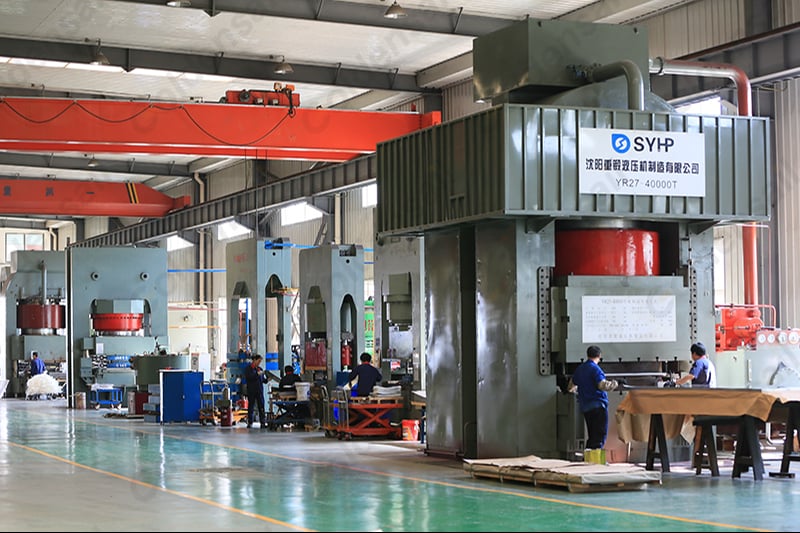
The plate is not bought in from a third party and re-sold with a margin stacked on it. JINFAN runs its own mould factory with more than 400 OEM plate moulds and presses up to 40,000 tonnes, so the cost of the pressed plate is controlled at source and the pattern can be matched to the duty instead of to a catalogue. On the alloy side, the specification is checked against the actual water or product analysis: titanium in clean cooling water adds price without extending life, and we say so. Where the numbers are close, the quotation includes the gasket and downtime comparison so the decision is made on total cost rather than on purchase price.
Mechanical disassembly is what makes a gasketed exchanger adaptable: plates can be added when a process is debottlenecked, removed when a duty shrinks, and inspected one by one when performance drops. None of that is possible with a welded pack. The surface area and the pass arrangement are fixed at manufacture, and a 20 % increase in flow two years later means a new unit rather than a longer pack.
The same limitation applies to inspection. On a gasketed unit an engineer can look at the plate surface and see the corrosion pattern directly; on a welded unit the assessment has to be indirect, through pressure drop, approach temperature and, where available, a borescope at the port.
Because the pack is not adjustable afterwards, the thermal design is checked against the operating range rather than only the design point: turndown, fouling allowance, CIP flow and any credible future increase are reviewed before the quotation is issued, and the surface is set with margin where the duty justifies it. When expansion is likely, JINFAN says so and proposes a semi-welded or gasketed execution, or a two-unit arrangement that can be extended later. A welded unit is the right answer for a stable duty; for a moving one it is an expensive answer.
A perforated plate or a failed seam in a welded pack is not a site repair. The affected cassette has to be cut out and re-welded under a qualified procedure with controlled heat input, then pressure and leak tested before it goes back into service. That work belongs in a workshop, which means the exchanger travels, and the plant waits — typically weeks rather than days, depending on the plate pattern and the port of departure.
Compare that with a gasketed unit, where a leaking section can often be re-gasketed in a shift with the exchanger in place. The difference is not in the frequency of repair but in the consequence of it, and it is the reason critical duties need a spare or a bypass before the failure happens rather than after.
Where the design allows, repair is done at cassette level rather than by rebuilding the pack, so only the affected section is replaced and the rest of the unit keeps its history. Weld repair is carried out under procedure with re-testing before release, and the plate pattern is held in JINFAN's own mould library, which shortens the lead time on a replacement cassette compared with a pattern that has to be re-tooled. For critical duties the recommendation is made at order stage: one spare cassette on the shelf costs far less than a production stoppage, and it is a decision the plant can still make cheaply at that point.
Weld quality is largely invisible after assembly. A joint with incomplete penetration or an undercut can pass a hydrostatic test at the works and still open up after a few hundred thermal cycles, and the failure will be attributed to the duty rather than to the weld. Plate gap tolerance is the second half of the problem: if the pressed depth varies across the plate, the channel is uneven, and the thermal performance and pressure rating both drift from the design in ways that no welding can compensate.
This is the limitation that buyers underestimate most often. A welded exchanger concentrates a great deal of process risk into a manufacturing step they cannot inspect, so sourcing on price alone transfers that risk directly into the plant.
Pattern and gap are controlled where they are created. JINFAN's mould factory has close to 30 years of plate mould development behind it and holds more than 400 OEM moulds, with plate areas from 0.03 to 3 m² and port sizes from φ28 to φ650 mm; the Botai plant runs 14 presses, including 40,000, 15,000, 10,000 and 6,000 tonne units, producing around 10,000 plates and 100 assembled exchangers a day. That volume matters for a welded product: repeatability comes from the tooling and the press settings, not from inspection at the end. The release routine on an assembled unit includes pressure and leak testing before it is packed.
GET A SELECTION CHECK
Send the operating conditions and we will tell you whether welded, semi-welded or gasketed is the better answer — including when the answer is not welded.
 EN
 AR
 FR
 DE
 PT
 RU