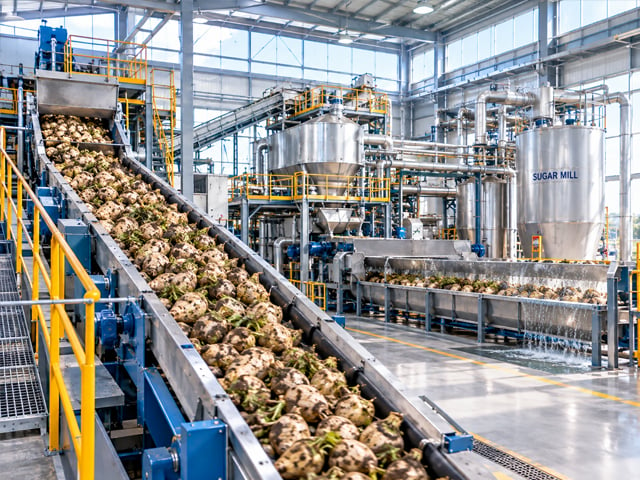
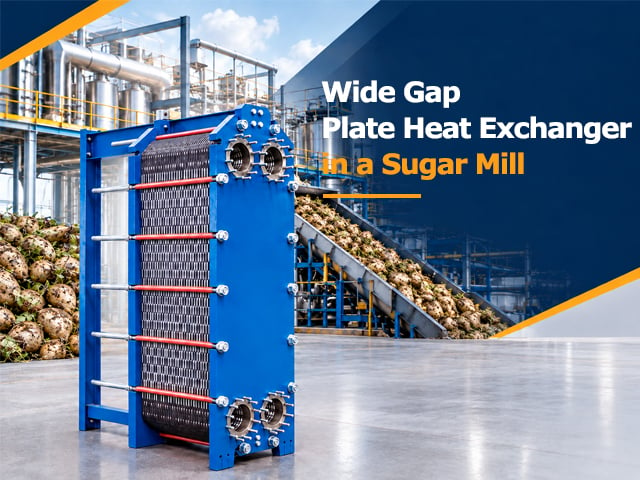
A sugar mill in northern China ran into the same wall that stops a lot of juice lines: the heat exchangers on the raw juice duties were plugging faster than the plant could clean them. The juice arriving at those exchangers carries bagasse fines, fibre, field soil and grit, and the milk of lime dosed to neutralise its acidity adds a flocculated solid load on top. On a standard-channel plate pack, that combination is a slow-motion blockage. The mill's answer was to specify Wide Gap Plate Heat Exchangers on both the juice preheating duty and the juice heating duty ahead of the evaporator station — an SF123 unit on preheating, a BR1.3 unit on heating. What follows is the problem as it presented itself, what the two duties actually see, and an honest account of what the change fixed.
Get in touchA standard Gasketed Plate Heat Exchanger is built around narrow channels. The herringbone pressing holds the PHE Plates a short distance apart and creates the contact points that keep the pack rigid while the chevron pattern forces turbulence at low flow. On clean water or a filtered product that geometry is exactly why a plate unit reaches a heat transfer coefficient several times that of a shell-and-tube exchanger in a fraction of the footprint. On raw juice, the same geometry works against you twice over.
Fibres and grit can bridge narrow channels. Once deposits start, blockage accelerates quickly.
Contact points trap fibres and scale, creating fouling that is harder to remove.
Northern growing regions make both problems arrive sooner. Heavier soils mean more silt and sand travelling with the harvested crop, so more grit survives extraction and screening and reaches the first heat exchangers. The lime added for clarification — and the calcium-based floc it forms — then adds a chemical fouling mechanism alongside the mechanical one.
In operational terms, the cost shows up as downtime rather than as a thermodynamic number: pressure drop climbing session by session, flow distributing unevenly across the pack, more unplanned stops to open the unit, plates handled far more often than they should be, and gaskets damaged during the scramble to clear a blockage.
In the sugar mill, the juice heat exchangers sit on either side of clarification, and the two duties carry very different solids loads.
Clarification starts with liming: milk of lime is dosed to raise the juice pH and neutralise its natural acidity, precipitating a large share of suspended and dissolved impurities as calcium salts. Clarification and filtration then take out most of that floc together with the soil, sand and grit that came in with the crop. Preheating and heating sit at different points relative to that boundary, which is why the two duties foul for different reasons.
| Duty | Juice at the Exchanger | Dominant Fouling Risk | Equipment at This Mill |
|---|---|---|---|
| Juice preheating | Raw juice still carrying bagasse fines, fibre, soil and grit, with lime floc present. | Channel plugging; fibre bridging and wrapping at plate contact points. | SF123 Wide Gap Plate Heat Exchanger |
| Juice heating Upstream of the evaporator station |
Clarified juice, with lime and most impurities already filtered out, at roughly 25% dissolved solids. | Residual fine solids combined with scale build-up on a hot surface. | BR1.3 Wide Gap Plate Heat Exchanger |
The preheating duty is the harder of the two. It sees the juice at its dirtiest, with the solids load that the rest of the line is designed to remove, and a standard-channel pack on that duty has to be opened constantly. The heating duty is cleaner of fibre but still hot, and still passing the fine solids that filtration inevitably lets through.
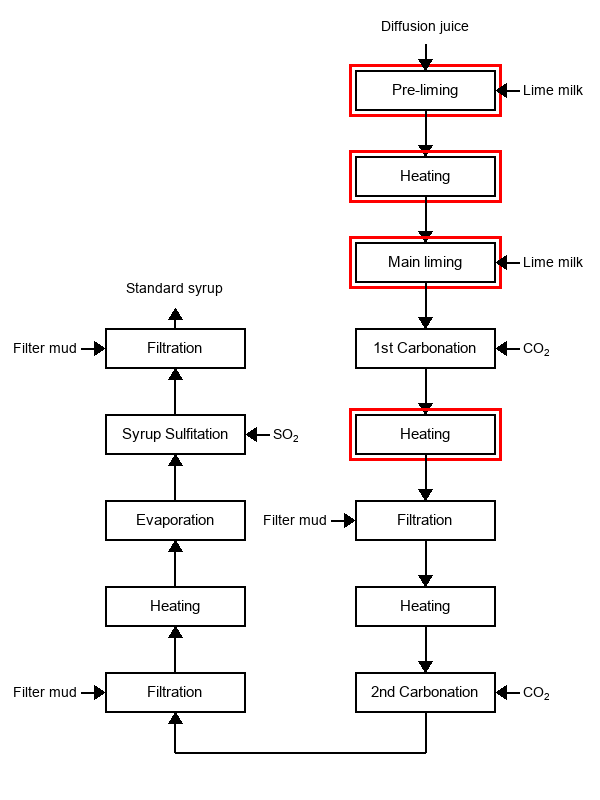
Sugar Production Process Flow Chart
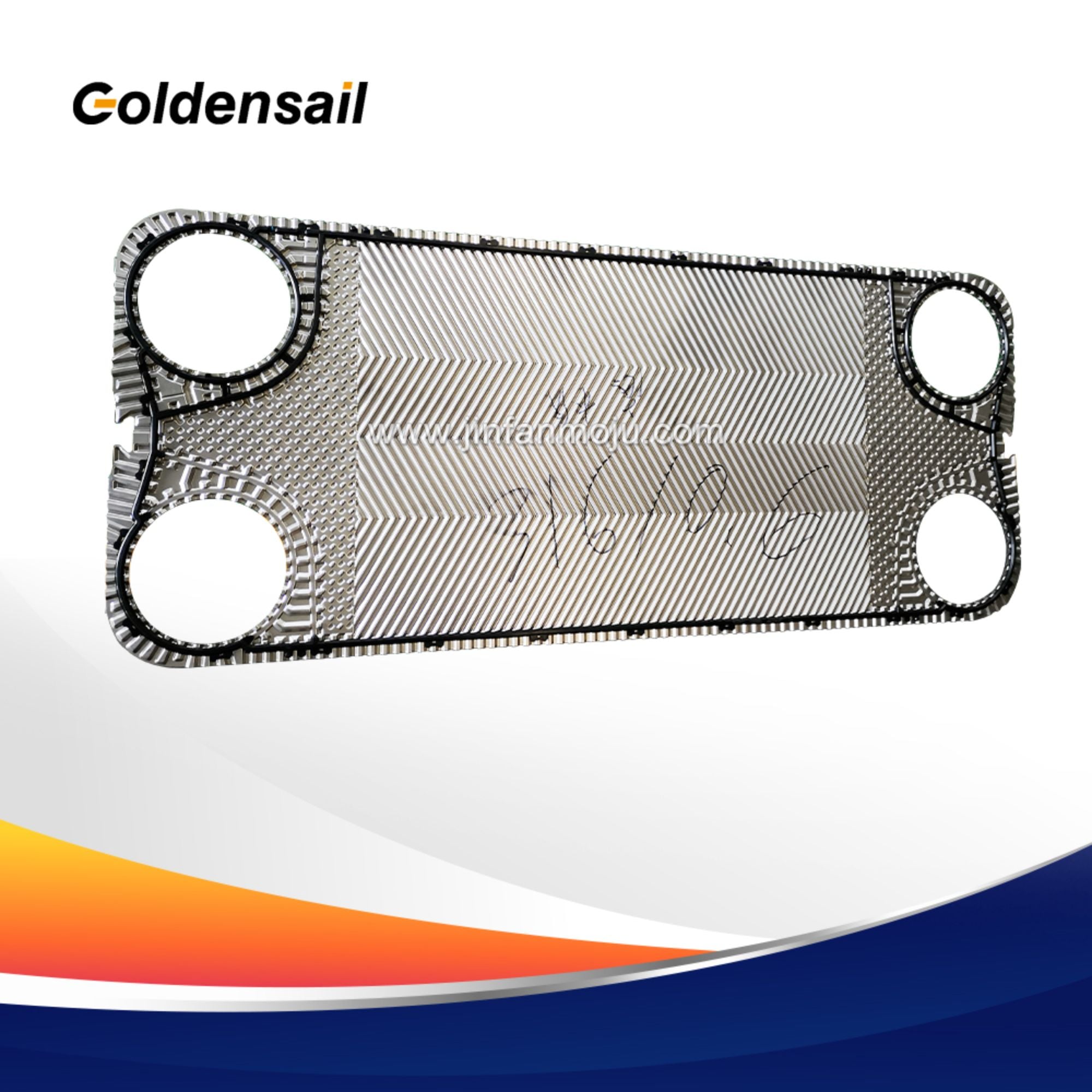
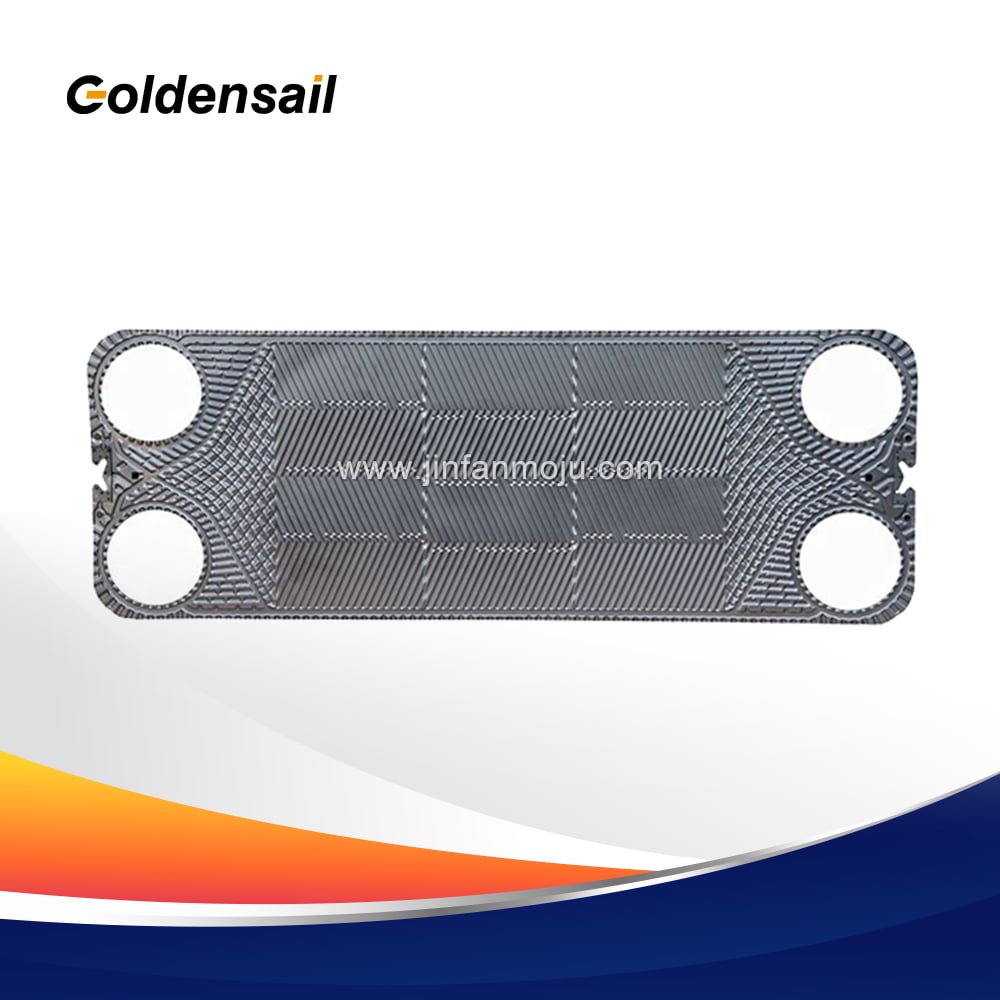
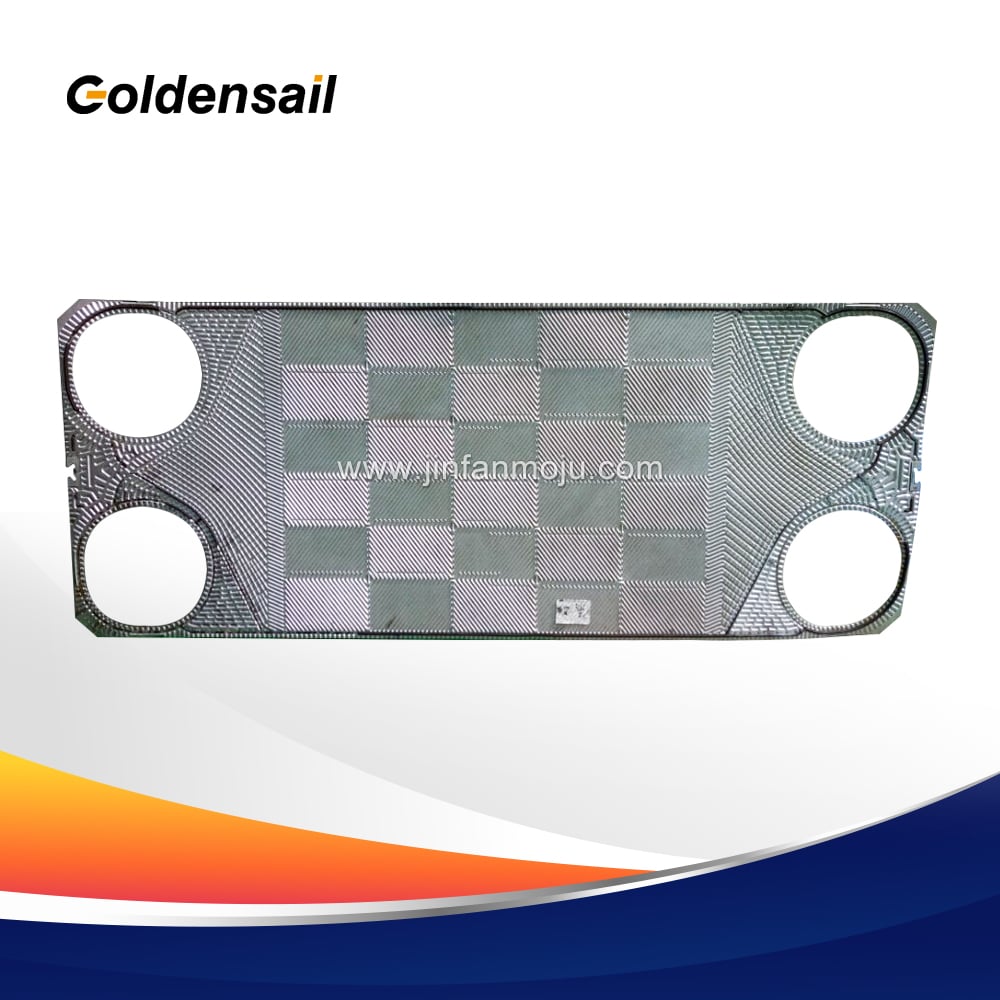
The wide gap plate — sold interchangeably as a free flow plate — keeps the same frame, the same pressed-plate principle and the same counter-current flow arrangement. What changes is the pressing depth and the pattern. The channel between plates is deeper, and contact points in the flow path are reduced or eliminated altogether. Two consequences follow directly from that geometry:
The channel is sized for the largest solid the juice can realistically carry. Particles and fibre that once caused bridging can now pass through the flow path.
With no contact points inside the flow path, fibre has fewer places to wrap and hold a channel closed, while scale forms on a smoother surface.
There is a third effect worth naming, because buyers ask about it: at equal flow, a wide-gap pack runs at a substantially lower pressure drop than a dense standard-channel pack on the same dirty duty. That is partly geometry and partly the absence of the partial blockages that quietly raise resistance over a production run.
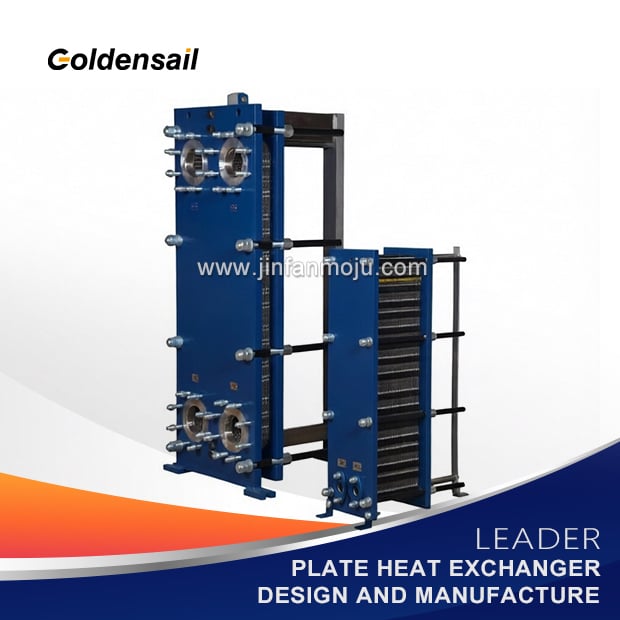
The units themselves are ordinary gasketed plate-and-frame construction. The plate packs are openable, which matters more here than on a clean duty — when the interval does come due, the pack is opened and the plates are lifted and washed individually. Wide gap changes how often that happens, not whether the plant can do it.
• Cleaning became condition-based
Instead of relying on a fixed cleaning schedule, maintenance could be planned around the actual condition of the exchanger and the observed pressure-drop trend.
• Plugging became less of a routine operating concern
The wider flow path allowed fibres and solids to pass through more easily, reducing the tendency for deposits to develop into flow-blocking fouling.
• Cleaning became simpler mechanical work
The plate pack could be opened, the plates lifted and washed, and the unit reassembled without dismantling extensive pipework or manually removing compacted fibre from narrow channels.
• Plate and gasket handling became less demanding
With fewer severe blockage events, there was less need to force open heavily fouled plate packs during maintenance.
• Pressure drop became a useful operating indicator
A stable pressure-drop trend provided a practical indication that the exchanger was continuing to pass solids rather than progressively collecting them.
If your sugar mill is fighting a fouling preheating or heating duty, send us three things: the juice analysis (solids content, particle size, fibre level, pH, chloride), the duty (flow, inlet and outlet temperatures, allowable pressure drop), and a note on what you clean with today. Our engineers will come back with a channel-geometry recommendation, an indicative plate area, and a cleaning regime built around a pressure-drop trigger rather than a calendar.
—
Related reading
- Why use Wide Gap Plate Heat Exchangers
- Investment Analysis of Plate Evaporators in Juice Concentration
 EN
EN
 AR
AR
 FR
FR
 DE
DE
 PT
PT
 RU
RU